
Healthcare · Procurement Optimization & Transformation
Multi-Site and SaaS Healthcare Companies Pay Too Much for the Things That Don't Heal Patients
Inside Consulting delivers healthcare procurement transformation across 100+ spend categories for operators scaling through acquisition, growth, or private equity ownership. We replace fragmented vendor relationships with a structured, leverage-based supply strategy. We do the work. You keep the savings.
Schedule a No Cost Spend AssessmentThe Problem
Healthcare Procurement Costs Scale Faster Than the Contracts Managing Them
Multi-site healthcare companies and health-tech SaaS businesses share a common financial leak: outside spend that grew by acquisition, urgency, or inertia rather than strategy. Each new location, each new software tool, each new vendor relationship adds cost without systematic management. By the time a CFO or PE operating partner looks closely, the indirect spend base has become a tangle of duplicated contracts, inflated rates, and missed leverage. Healthcare procurement transformation starts with making that spend visible and then building the structure to control it.
Location Sprawl, Price Chaos
Multi-site DSO and physician group operators often run 20, 50, or 100+ locations, each with its own vendor relationships and rates. Procurement consolidation savings exist at every level; they just require someone to find them.
SaaS Proliferation
The average healthcare SaaS company manages 275+ software applications. Unused licenses, auto-renewed contracts, and redundant tools are the norm. No one owns the rationalization until margins compress.
Acquisition-Driven Fragmentation
PE-backed roll-ups inherit the vendor portfolios of every acquired entity. Harmonizing those portfolios into a single, leveraged supply base is both a procurement transformation problem and a significant EBITDA opportunity.
No Procurement Infrastructure
Mid-market healthcare operators rarely have formal procurement or supply chain functions. Finance owns the budget; operations owns the vendor. Neither has the time, market data, or category expertise to drive systematic cost reductions.
What We Reduce
Procurement Category Coverage Built for Healthcare Operators
We work across 100+ SG&A spend categories. Below are the highest-impact procurement cost reduction areas for multi-site healthcare operators and health-tech SaaS companies specifically.
Multi-Site / DSO Operators
Location-Level Spend
- Medical supplies (consumables, disposables, PPE)
- Specialty medical supplies
- Pharmaceuticals
- Dental supply consolidation
- Equipment service contracts & maintenance
- Facilities management & janitorial
- Waste disposal & biohazard removal
- Uniform & workwear programs
- Pest control & environmental services
- Print, signage & branded materials
- Background screening & credentialing
SaaS / Health-Tech Companies
Technology & Corporate Spend
- SaaS license rationalization & right-sizing
- Cloud infrastructure (AWS, Azure, GCP)
- Telecom & connectivity
- Cybersecurity & compliance tooling
- Recruitment & talent acquisition fees
- Professional & managed services
- Corporate travel & T&E programs
- Benefits administration & HR vendors
- Marketing & agency spend
- Office & remote work infrastructure
Shared — Both Segments
Enterprise-Wide Categories
- Revenue cycle management fees
- Group purchasing & GPO optimization
- Merchant processing & payment fees
- Logistics & freight
- Office supplies & consumables
- Copier & document management
- Subscription & media spend
- Fleet & vehicle programs
Our Approach
How Our Healthcare Procurement Transformation Process Works
Inside Consulting runs healthcare procurement transformation engagements end-to-end, from spend discovery through vendor negotiation to realized savings. Healthcare operators don't have procurement departments. We are yours.
Spend Discovery
We map your full outside spend base across all locations, entities, and vendors to identify the categories with the highest procurement cost reduction potential. This is the foundation everything else is built on.
Weeks 1–4What we do in this phase
- Extract and normalize accounts payable data across all entities
- Map spend by vendor, category, and site into a unified spend cube
- Identify the top categories by spend magnitude
- Flag vendor fragmentation and contract gaps
- Deliver a prioritized opportunity map to your team
Category Analysis
We analyze contract gaps, assess vendor leverage, and prioritize categories by savings magnitude and speed to capture.
Weeks 3–8What we do in this phase
- Assess contract status, terms, and expiration dates across all vendors
- Evaluate clinical sensitivity and switching cost for each category
- Identify leverage points specific to each vendor relationship
- Size savings potential for each prioritized category
- Develop negotiation strategy and identify competitive alternatives
Vendor Negotiation
We lead all vendor conversations, armed with category expertise and credible alternatives. You stay out of it. We drive procurement cost reductions without disrupting your operations or existing relationships.
Months 2–6What we do in this phase
- Run competitive sourcing processes across targeted categories
- Lead all vendor conversations and RFP responses
- Apply volume consolidation leverage across multi-site portfolios
- Negotiate pricing, terms, and service levels simultaneously
- Manage clinical stakeholder alignment where relevant
Savings Realization
We track and verify savings against a defined baseline, ensuring commitments become captured EBITDA rather than projected opportunities that never materialize on the P&L.
Months 3–9What we do in this phase
- Establish a verified savings baseline before any changes go live
- Track realized savings against baseline by category and vendor
- Confirm new pricing is being honored in actual invoices
- Address maverick spend and off-contract purchasing
- Deliver regular savings reporting to finance and PE sponsors
Governance & Holdback
We document contracts, set renewal alerts, and install lightweight governance so procurement savings don't erode as your company continues to grow, acquire, or add headcount.
Month 6 onwardWhat we do in this phase
- Build preferred vendor lists and purchasing guidelines by category
- Centralize contract storage and set expiry and renewal alerts
- Define onboarding path for future acquisitions into the supply base
- Establish escalation process for off-contract spend exceptions
- Hand off governance documentation to your finance or ops team
M&A Integration
Healthcare M&A Creates Procurement Leverage. We Help You Set and Capture It.
Healthcare systems pursuing M&A face specific challenges in realizing procurement synergies. The combined entity has more purchasing power on paper, but fragmented vendor portfolios, inherited contracts, and integration bandwidth constraints mean most of that value stays on the table. Inside Consulting runs the procurement integration workstream end-to-end, so your team stays focused on organizational integration while we build and deliver the supply-side savings case.
Why Procurement Synergies Underdeliver in Healthcare M&A
Most deal models apply a generic savings percentage to an aggregate spend number rather than building the case from the bottom up by category. The result is a target that reflects what is easy to defend at signing, not what is actually available.
When volume consolidation is the entire savings thesis, that value is often already reflected in the acquisition price. The real upside lives in competitive displacement and demand management, which require category-level analytical work most integration teams never do.
PE-backed roll-ups inherit every acquired company's vendor relationships, rates, and contracts. Without active consolidation, the combined entity pays well above market in fragmented categories simply because no one has rationalized the portfolio.
Post-close integration absorbs enormous management attention on organizational structure, systems, and culture. Procurement gets delegated to finance teams who lack category expertise and market leverage, and synergies drift without a dedicated workstream owner.
The M&A Synergy Gap in Healthcare
The Three Procurement Levers We Apply in M&A Integration
Lever 1
Volume Consolidation
Combining purchasing scale across the merged entity to secure better unit pricing from existing vendors. The most common lever in deal models and typically the floor, not the ceiling, of what is achievable.
3–8% savingsLever 2
Demand Management
Questioning how many units the combined organization actually needs. Utilization audits, specification rationalization, and service model efficiency across the merged spend base often produce 2x the savings of volume leverage alone.
10–20% savingsLever 3 — Most Underused
Competitive Displacement
Credibly threatening, and where warranted executing, a supplier transition. In categories where incumbent vendors carry embedded margin and switching cost is manageable, this lever produces results that renegotiation alone cannot match.
15–25% savingsWe help healthcare acquirers set credible, category-level procurement savings targets before close and then own the workstream that delivers them.
Read: The Procurement Blind Spot in Healthcare M&A → Schedule a Spend AssessmentClient Results
Healthcare Procurement Engagements, Delivered
A sample of our procurement cost reduction work in healthcare, spanning multi-site operators, health-tech platforms, and PE-backed roll-ups.
Multi-Site Healthcare
US Eye
$2.4M vendor spend reduction 25% overall cost compression on categories addressed
Multi-site ophthalmology platform. Procurement optimization across medical supplies, facilities, and other non-clinical categories.
View Case Study →Healthcare Technology
naviHealth
$6M+ annual EBIT 4-year engagement spanning sourcing, ZBB, and SaaS net revenue retention
PE-backed health-tech platform. Strategic sourcing, zero-based budgeting, and SaaS optimization across a complex technology spend base.
View Case Study →Multi-Site Healthcare
Harmony Cares
$1.7M/year vendor spend reduction 39% savings from baseline through demand management and pricing levers
Home-based primary care provider operating across multiple states. Procurement cost reduction through pricing renegotiation and demand management.
View Case Study →Healthcare SaaS
Icario
$2.7M vendor spend reduction Call center costs ($1.9M) and commercial printing ($800K)
Healthcare engagement platform. Significant reductions in two high-spend categories through competitive sourcing and demand management.
View Case Study →Multi-Site Healthcare
Millennium Physicians Group
$2M+ EBITDA improvement Janitorial, medical supplies, and telephony
Large multi-site physician group. Procurement optimization across facilities and clinical supply categories at scale.
See All Clients →Healthcare Technology
Office Practicum
$1M recurring EBITDA Plus $740K in additional savings identified
Pediatric EHR and practice management platform. Vendor spend reduction and revenue leakage elimination across a PE-backed health-tech company.
View Case Study →Selected healthcare clients


Thought Leadership
What We Know About Healthcare Procurement Optimization
Our partners write from experience, not theory. The pieces below represent the frameworks and findings we use in healthcare procurement engagements every day.
White Paper
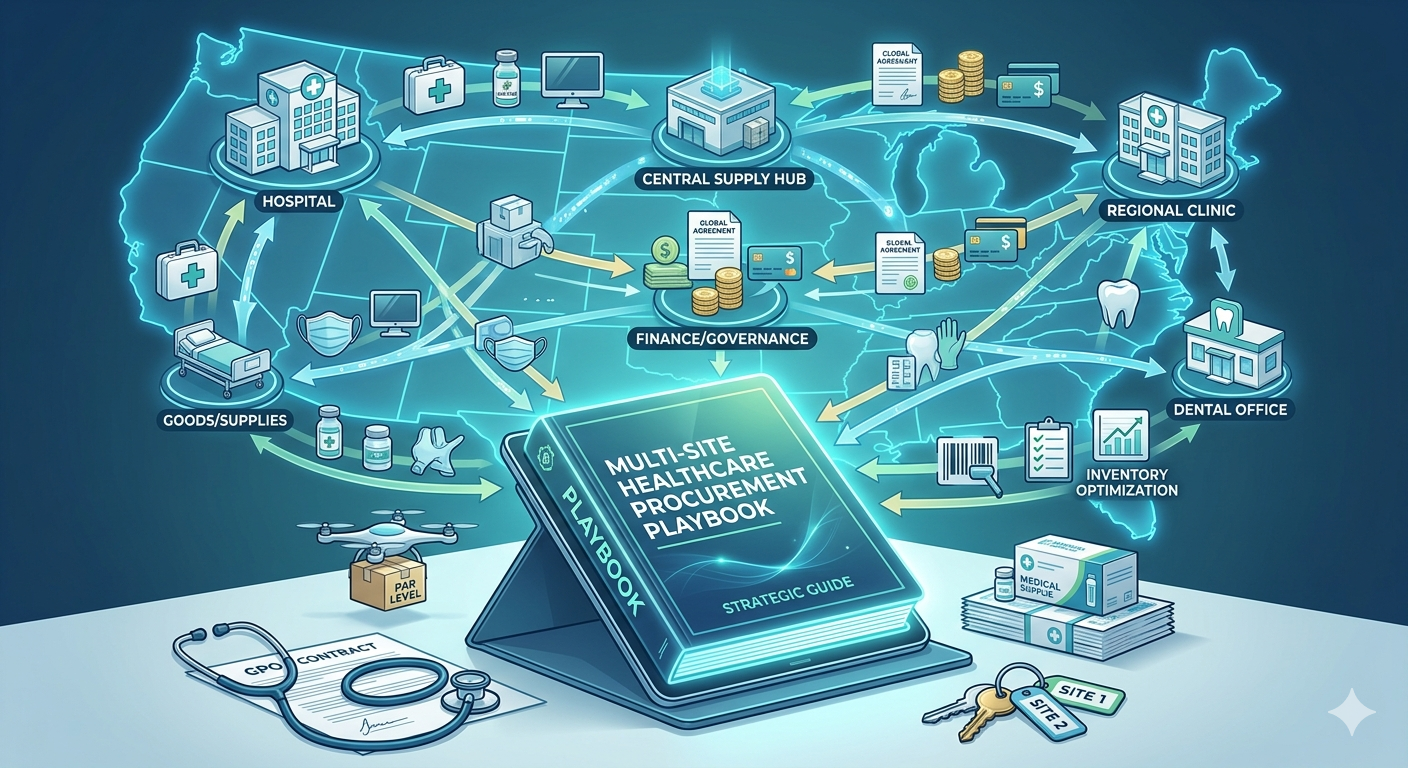
Capturing Procurement Value in Multi-Site Healthcare Acquisitions
A full operator playbook for PE sponsors and C-suite executives. Covers spend visibility, vendor consolidation, GPO strategy, IT rationalization, and governance through ongoing M&A.
Read the White Paper →
Insight
Healthcare M&A Synergy Capture: The Procurement Blind Spot
Healthcare acquirers leave EBITDA on the table by defaulting to volume leverage as the only synergy lever. We explain the data and how a category-level approach closes the gap.
Read the Insight →
Framework
Why Relying on GPOs Isn't Always the Best Plan: When Custom Sourcing Pays Off
GPO reliance results in 8 to 15% higher spend than custom sourcing in certain categories. We offer a three-factor framework for deciding which approach to use, by category.
Read the Framework →
Insight
Sourcing: The Most Underexploited M&A Synergy Lever
Most post-merger integrations capture only a fraction of available sourcing synergies. We show how a category-level approach delivered nearly 2x the initial synergy target in a real engagement.
Read the Insight →Why Inside Consulting
Built for Healthcare Companies That Need Procurement Transformation Without Building a Department
Healthcare operators growing through acquisition or organic expansion have a narrow window to capture cost synergies before the next raise, recapitalization, or exit. We move fast, go deep, and work on your timeline.
Operator Credentialing
Our partners are McKinsey- and BCG-trained, with military leadership backgrounds that shaped how we approach complex operational problems. Across numerous healthcare procurement engagements spanning multi-site operators, PE-backed platforms, and health-tech companies, we have a consistent track record of delivering material results, not estimates.
At-Risk Fee Options
We offer engagement structures that tie our compensation directly to realized savings, including hybrid and at-risk fee models. If we don't find procurement savings, you don't pay the same. Period.
No Software. No Platform.
We don't sell a SaaS tool that requires your team to implement it. We do the procurement category work directly, handling analysis, negotiation, and implementation with minimal burden on your finance or operations teams.
Mid-Market Focus
We don't serve the Fortune 500. We work with $75M to $1B healthcare companies where a dedicated procurement transformation initiative delivers disproportionate EBITDA impact relative to its cost.
PE Fluent
We speak the language of private equity: EBITDA improvement, MOIC, value creation plans, and 100-day priorities. Our procurement engagements are designed to appear on a board deck and survive due diligence.
Speed to Savings
We identify and deliver first procurement savings within 60 to 90 days. Healthcare operators on PE timelines can't wait for a 12-month process. We structure engagements to produce early wins and build from there.
What healthcare procurement transformation actually looks like
Healthcare procurement transformation is not a software implementation or a GPO switch. It is the process of replacing fragmented, location-level vendor relationships with a structured, leverage-based supply strategy, built on spend visibility, competitive sourcing, and governance that holds. Inside Consulting has executed this work for multi-site operators at every stage of the PE hold cycle, from 100-day value capture through pre-exit margin improvement. The result is not just lower costs in one category. It is a supply base your organization can actually manage as it continues to grow.
Common Questions
Frequently Asked Questions
What is healthcare procurement optimization consulting?
Healthcare procurement optimization consulting is the systematic process of reducing what a healthcare company spends with outside vendors, across categories like medical supplies, pharmaceuticals, SaaS software, facilities, and other indirect spend. A procurement optimization consultant analyzes your current vendor contracts, identifies where you are overpaying relative to market rates, and leads negotiations to capture verifiable cost reductions. Some operators refer to this work as healthcare procurement transformation, particularly when the goal extends beyond one-time savings to building a durable supply strategy and governance infrastructure. Inside Consulting does this work end-to-end for mid-market and PE-backed healthcare operators.
How do mid-market healthcare companies reduce procurement costs?
The most effective approach combines spend visibility, competitive sourcing, and vendor consolidation. First, you need a complete picture of what you are spending, with whom, and under what contract terms. Most mid-market healthcare companies lack this view because spend is fragmented across locations, entities, or departments. Once you have that baseline, you can prioritize categories by savings potential, run competitive sourcing processes, and consolidate volume to create negotiating leverage. Inside Consulting runs this entire process for clients, from spend mapping through contract execution and savings verification.
Does this work for healthcare companies that aren't PE-backed?
Yes. While many of our clients are PE-backed or approaching a liquidity event, we work with privately held and founder-led healthcare companies as well. The driver is size. Companies above $450M in revenue typically have enough outside spend to warrant a systematic procurement cost reduction program.
How long does a typical healthcare procurement engagement take?
Engagements typically run 6 to 12 months. For multi-site operators, the spend discovery and baseline phase takes 3 to 4 weeks. First negotiated savings typically follow within 60 to 90 days of engagement start. The full savings program runs through contract execution and implementation across all targeted categories.
What does an at-risk fee structure look like?
Under an at-risk structure, our fees are linked to verified, realized savings rather than projected estimates. We work with you to define a savings baseline and measurement methodology upfront. Our compensation is then tied to what we actually deliver. We also offer hybrid models (partial retainer, partial at-risk) that work well for companies that need more billing certainty.
We're a SaaS health-tech company. Do you work on software and cloud costs specifically?
Yes. SaaS license rationalization, cloud infrastructure spend (AWS, Azure, GCP), and technology vendor management are core categories we address. We conduct usage audits to identify license waste and lead renegotiations directly with vendors and resellers. The average SaaS company can reduce software spend by 20 to 35% with a structured audit and renegotiation process.
How much internal time will this require from our finance or operations team?
We design our engagement model specifically to minimize the burden on your team. Initial spend data collection requires 4 to 8 hours from a finance contact. After that, we lead all vendor interactions, negotiations, and category analysis independently. Our clients describe the process as "we handed it to Inside and got results back." That's by design.
Can you work across multiple entities or roll-up companies?
Yes. This is one of the highest-value applications of our procurement work. PE-backed healthcare roll-ups often hold 5, 10, or 20+ acquired entities, each with its own vendor relationships and contracts. We consolidate and harmonize those into a single leveraged supply base, capturing volume-based savings that no individual entity could negotiate on its own.
Do you help with medical supplies and pharmaceuticals, or only non-clinical spend?
Both. Medical supplies, specialty medical supplies, and pharmaceuticals are among the highest-spend categories in multi-site healthcare and are often among the most addressable. We work alongside clinical leadership to evaluate alternatives and structure competitive sourcing processes that don't compromise patient care standards.
How does healthcare procurement consulting differ from using a GPO?
A group purchasing organization (GPO) gives you access to pre-negotiated contracts across a portfolio of vendors. That can be useful for certain categories, but GPO pricing is not always the best available rate, particularly for healthcare companies with enough volume to negotiate custom agreements. A procurement consulting firm like Inside Consulting evaluates each category independently, determines whether a GPO, a custom negotiation, or a competitive RFP produces the best outcome, and then executes accordingly. In many cases, we find that custom sourcing outperforms GPO pricing by 8 to 15% on specific categories.
Find Out What Your Healthcare Company Is Overpaying
We'll run a no-cost spend assessment and give you a category-level view of where procurement savings are most likely, before any engagement begins.
Request a Spend Assessment See Our Full Approach