
Revenue Leakage Recovery for Mid-Market Companies
Inside Consulting helps mid-market and PE-backed companies find and recover revenue leakage, the money you already earned but never collected through underbilling, unprovisioned changes, and pricing drift. We find it, recover it, and close the loop so it stays fixed.
In our experience, mid-market companies leak 2 to 3% of the revenue they should collect, quietly, through the gaps between quoting, provisioning, billing, and renewal. A senior team of former McKinsey and BCG consultants runs a fast, hypothesis-driven diagnostic, recovers the leakage alongside your team with no disruption, and puts a closed-loop process in place. Fees at risk.
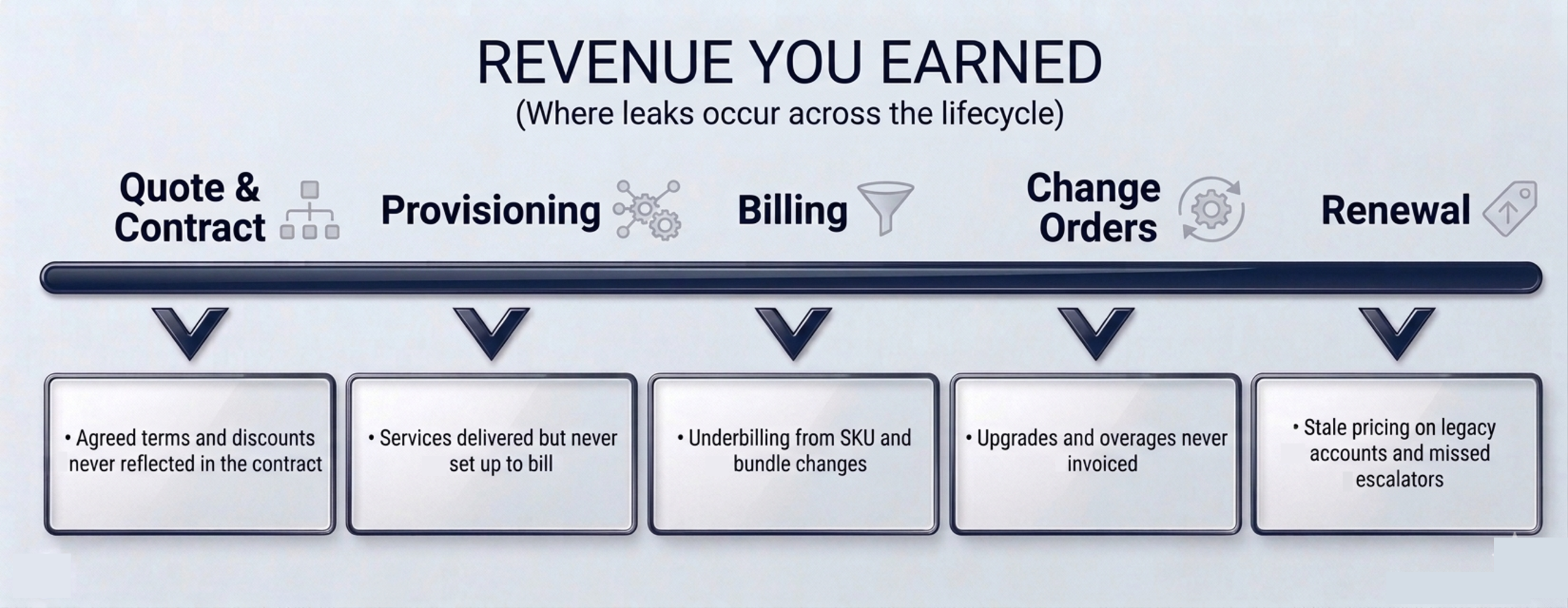
Where revenue leaks
Revenue rarely disappears in one place. It slips out at the handoffs between teams and systems, where no one owns reconciliation. Each stage from quote to renewal is a place it can go uncaptured.
How we find and recover it
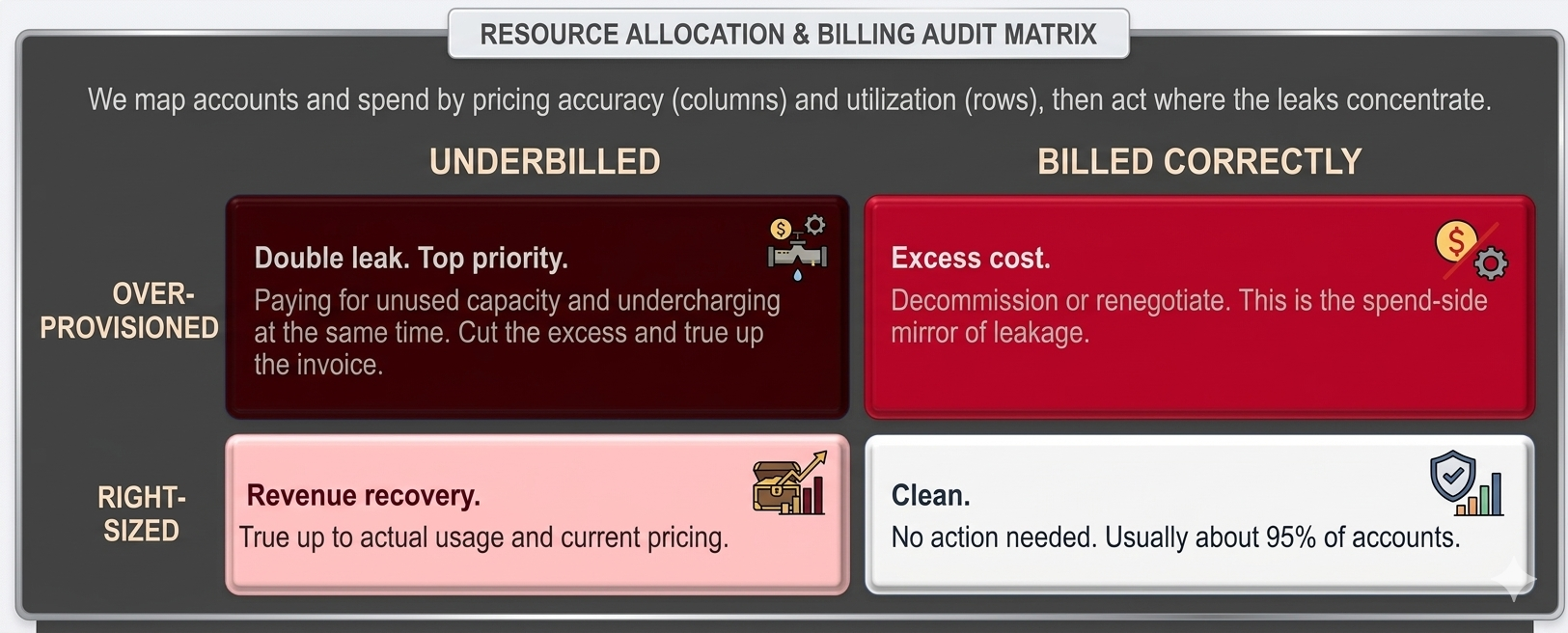
Finding leakage is not typical procurement or process work. You are hunting the 2 to 5% of accounts that are wrong, with limited data, which takes analytical horsepower, creativity, and pattern recognition from having seen it before. Our diagnostic is hypothesis-driven: we sample key accounts and vendors, rule out the clean cases fast, and concentrate effort in the richer veins.
Results we have delivered
Real engagements, real recovery. Each links to the full case.
$550K recovered from provisioning and billing gaps
Facing price and margin pressure, the company had never run a rigorous reconciliation of its resold SKUs. We built hypotheses to direct targeted audits and found excess volume from failed decommissions and revenue leakage from underbilling, then corrected the disconnects between provisioning and billing.
"What stood out was their ability to focus on key issues, perform detailed analytics, and drive opportunities to closure."
Jeff Coursen, CEO
Systemic leakage, found and fixed
Complex product bundles and changing pricing had created systemic revenue leakage on a product line. We identified the price realization opportunity and corrected it, with no disruption to staff.
Read the Office Practicum case →Recovering renewal pricing upside
Pricing on legacy SaaS accounts had drifted below value delivered. We lifted net revenue retention and surfaced clear renewal pricing upside the business had been leaving on the table.
Read the naviHealth case →Two sides of the same coin
Revenue leakage has a mirror image on the cost side: paying vendors for services you do not use. Both come from the same root cause, the absence of systematic reconciliation, and we find and fix them together. The leakage you recover and the spend you stop wasting both fall straight to EBITDA, at low risk, because you are correcting errors rather than asking customers to pay more.
Read our perspective on revenue leakage and demand management, or see how we compress the cost side through strategic sourcing.
Frequently asked questions
What is revenue leakage?
Revenue leakage is money a company has earned but never collects, through underbilling, services that are provisioned but never set up to bill, failed decommissions, uninvoiced upgrades and overages, and pricing that drifts on legacy accounts. In our experience, mid-market companies leak 2 to 3% of the revenue they should collect.
What causes revenue leakage?
Three root causes drive revenue leakage at scale. First, weak data and system integration: quoting, contracting, provisioning, and billing operate out of sync, so mismatches accumulate unseen. Second, misaligned culture and incentives: sales is rewarded for closing, operations is reluctant to terminate services, and no one owns reconciliation. The combined effect shows up as pricing discrepancies in roughly 2 to 5 percent of accounts. Third, pricing policy drift: rate changes and post-merger pricing differences go unreconciled, leaving customer accounts on outdated pricing or legacy discounts for years.
How do you find revenue leakage?
With a fast, hypothesis-driven diagnostic. We sample key accounts and vendors, run targeted reconciliations and audits, rule out the clean cases quickly, and concentrate on the situations and product bundles where leakage is most likely. It is not typical procurement or process work. It takes analytical horsepower and pattern recognition to find the small share of accounts that are wrong with limited data.
How is revenue leakage different from churn or pricing strategy?
Leakage is revenue you already earned and simply failed to capture. It is distinct from churn, which is customers leaving, and from pricing strategy, which is setting the right price in the first place. Recovering leakage is lower risk than either, because you are correcting errors and enforcing terms you already agreed, not asking customers to pay more.
Do you just identify leakage, or do you recover it?
We recover it. We work alongside your team to true up invoices and contracts and to install a closed-loop process so the leakage stays fixed, with no disruption to staff. Our fees are at risk against the result.
How long does it take?
The diagnostic moves in weeks. Because the work corrects existing errors rather than renegotiating with customers, recovery can begin quickly and at low risk, and the closed-loop process keeps the benefit in place over time.