
We diagnose fast, because turnarounds reward speed
Turnaround situations reward speed and punish indecision. Our diagnostic is fact-based and built bottom-up, not pulled from benchmarks, so the path forward is clear in weeks and the numbers are ones your leadership can stand behind.
A senior team of former McKinsey and BCG consultants does the analysis, and real operating backgrounds let us cut through complexity, prioritize ruthlessly, and focus on the levers that actually move the needle. Then we stay to help capture the value rather than handing over a deck.
Where the earnings come from
We pull cost and revenue levers together and sequence them by speed and certainty of impact. The biggest gains rarely come from payroll.
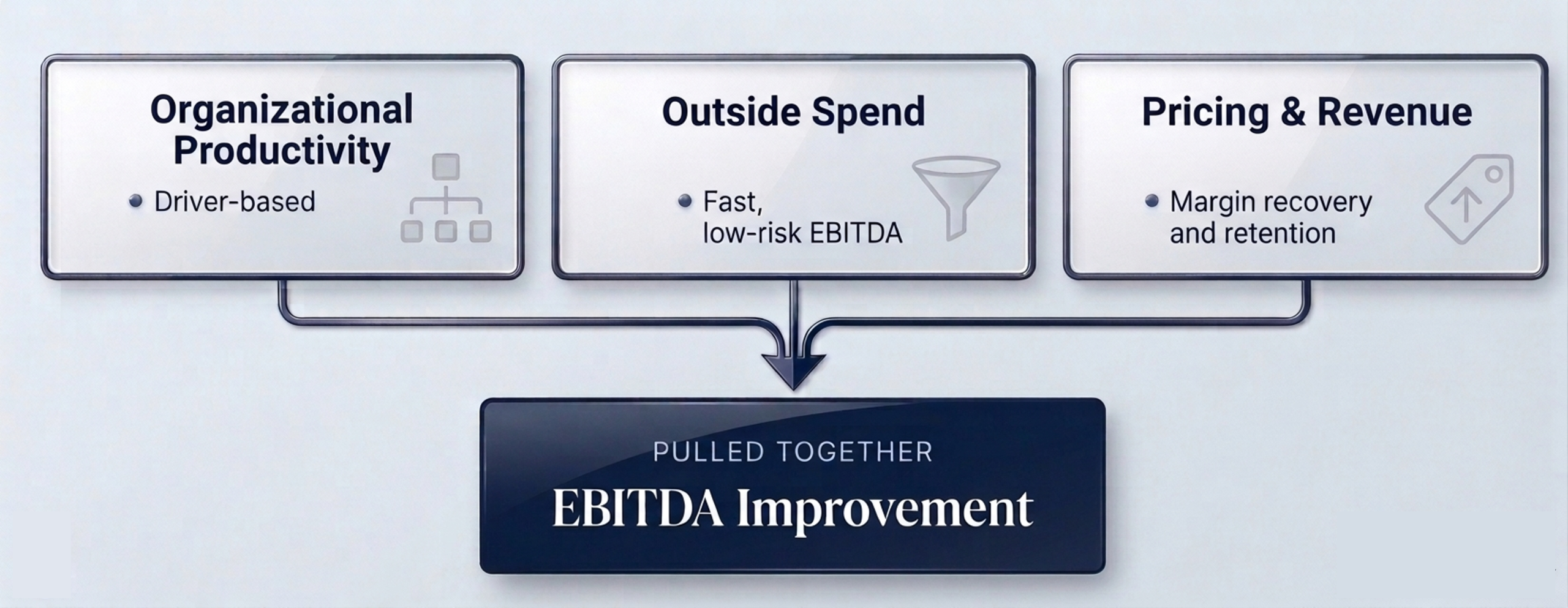
Productivity, not headcount cuts
Driver-based analysis shows where to invest as often as where to trim. At Hosting, our zero-based review found support teams that had become more productive over time and needed more investment, not less. That is the difference between a driver-based approach and across-the-board cuts: faster buy-in, fewer regrettable losses, and a cost structure the business can actually run on.
Fast, low-risk EBITDA from outside spend
Outside spend is usually the fastest, lowest-risk earnings lever in a turnaround. We compress it through strategic sourcing, reverse auctions, and multi-round tenders, capturing 15 to 25% on average across categories. See our procurement optimization approach for the full method.
Recovering margin from pricing and revenue
Underpriced inelastic products, undisciplined discounting, and revenue leakage quietly drain margin, and in a downturn they worsen as teams concede price to hold volume. We find where price can hold, where leakage is occurring, and where retention and mix can improve, then pilot and scale with your sales operations team.
Results we have delivered
Real engagements, real outcomes. Each links to the full case.
Back to profitability after an 80% demand collapse
A $500M construction materials business was consuming cash at an unsustainable rate after end-market demand fell 80% from peak. We found price and demand savings across most categories at 15 to 25%, surfaced a footprint option the team had not previously considered, and restored pricing discipline on inelastic product lines.
"Time and again our improvement targets were greatly exceeded due to Rick and his team's creative, outside the box thinking. They changed how I think about managing our outside spend."
Derek Taylor, Chief Financial Officer
Restarting stalled earnings
Earnings growth had been flat for nearly a year. We identified make versus buy and product redesign opportunities, drove material savings averaging over 15%, and repriced underpriced spares and maintenance.
Read the Swisslog case →Margin recovery under competitive pressure
Facing new IaaS competition near the end of the hold period, we compressed targeted spend, ran a zero-based review across overhead and sales and marketing, and piloted revenue growth in an underserved segment.
Read the Hosting case →Cost and revenue reset during a model shift
An MSP under margin pressure while transforming to a solutions model. We reset the cost structure, recovered $2M per year of billing leakage, and shifted pricing from labor-based to value-based.
Read the Data Intensity case →Cost reform that funded reinvestment
After margin and stock decline and a new CEO, we rezeroed a $20M marketing budget against real drivers, renegotiated key contracts at 23% average savings, and rebuilt a leaking pricing structure.
Read the DHI case →We diagnose, then we execute.
Most consultants hand you a deck. We work alongside your management team to capture the value, and we put our fees at risk to back it. Our senior team of former McKinsey and BCG consultants pairs top-tier analytics with real operating experience, so the plan is both rigorous and runnable.
"Consultants who do more than create groovy PowerPoints with awesome heat maps. If you are super busy running an MSP and your gut tells you there are things going on that you cannot see, call Inside Consulting. They won't waste your time."
Phil LaForge, CEO, Data Intensity
Frequently asked questions
What is operational restructuring, and how is it different from financial restructuring?
Operational restructuring resets a company's cost base and operating model to restore profitability, working the spend, pricing, productivity, and footprint levers. It is distinct from financial restructuring, which addresses the balance sheet, debt, and liquidity. Inside Consulting focuses on the operational side, the levers that improve EBITDA and cash earnings, and partners with whatever financial advisors a given situation calls for.
How fast can you improve EBITDA in a turnaround?
Our diagnostic is built to move in weeks, not months, and our engagements have returned businesses to profitability within 12 months. At Monier, a business in freefall after an 80% demand drop was profitable again within a year. Speed comes from a fact-based, driver-based approach and from staying to help execute rather than handing over a report.
How do you reduce costs without damaging the business?
By being driver-based rather than across-the-board. Arbitrary percentage cuts destroy capability and buy-in. We rebuild budgets from real drivers, which often shows where to invest as well as where to trim. At Hosting, our review found support teams that had become more productive and needed more investment, not cuts. The largest savings usually come from outside spend and pricing, not payroll.
What is the difference between a turnaround and a performance improvement engagement?
A turnaround addresses a business in distress or steep decline, where speed is critical. Performance improvement targets a fundamentally healthy business that is leaving profit on the table. The toolkit is largely the same, a fact-based diagnostic, cost and revenue levers, and execution support, but the urgency and sequencing differ.
Do you only diagnose, or do you help execute?
We execute. We work alongside your management team to capture the value, and we put our fees at risk. Our operating backgrounds mean we can step into the work, not just advise on it.
What size companies do you work with?
We focus on the middle market and PE-backed companies, across sectors including construction materials, healthcare manufacturing, technology, and managed services. Engagements have ranged up to businesses of $500M or more in revenue.