
Healthcare procurement transformation: what it is, why it fails, and how mid-market operators get it right
Insights Article
A guide for CFOs and PE operating partners at mid-market healthcare companies

Dan Bleicher Partner, Inside Consulting
Published May 28, 2026
Healthcare Procurement Transformation Series
What healthcare procurement transformation actually means
Healthcare procurement transformation is one of the most misused terms in operational consulting. For many organizations, it gets reduced to switching GPO contracts or deploying a spend management platform. Neither qualifies.
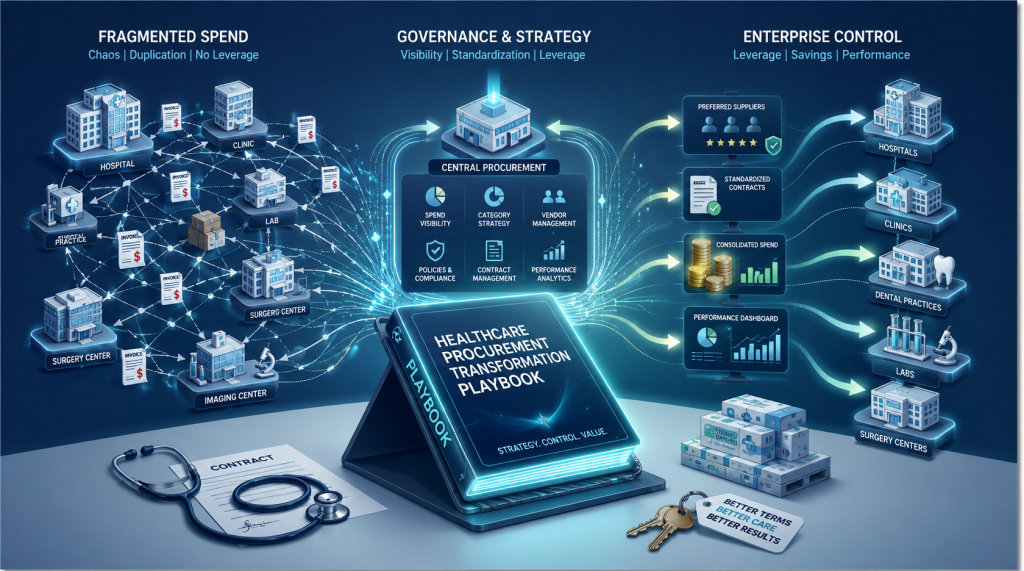
Healthcare procurement transformation replaces fragmented vendor relationships with a structured enterprise sourcing strategy built on spend visibility, competitive sourcing, and governance that holds over time. The distinction matters because most failed procurement initiatives treat transformation as a software deployment or a one time negotiation exercise rather than an operational redesign.
For multi-site healthcare operators, procurement fragmentation typically mirrors the way the organization was assembled: one location at a time, one vendor relationship at a time, with little centralized visibility. Transformation changes the underlying purchasing architecture by consolidating spend, negotiating enterprise pricing, and creating governance structures that sustain savings over time.
Why most procurement transformation efforts fail
No spend visibility before negotiations
Organizations that enter vendor negotiations without clean spend visibility have no baseline, no leverage, and no reliable method for validating savings. Vendors understand this dynamic and frequently price against fragmented purchasing behavior.
No governance infrastructure
Negotiated savings disappear quickly when organizations fail to build governance infrastructure. Without preferred vendor enforcement, compliance tracking, renewal management, and acquisition onboarding discipline, procurement savings erode over time.
Over reliance on GPO pricing
GPOs can create value in commodity categories, but they are not a procurement strategy. Many mid-market healthcare operators have sufficient scale to negotiate materially better pricing through enterprise sourcing and competitive bid processes.
The transformation framework
Well-run healthcare procurement transformation engagements typically follow a five phase process:
- Spend discovery and invoice aggregation
- Category analysis and sourcing prioritization
- Competitive vendor negotiations
- Savings realization and validation
- Governance implementation and compliance tracking
Skipping steps is one of the primary reasons procurement transformation efforts fail. Sustainable savings require sequencing, governance, and operational adoption.
What good looks like after 12 months
A successful healthcare procurement transformation engagement produces measurable operational change. Enterprise vendor tiers are active, savings are visible in financial reporting, contract governance processes exist, and new acquisitions onboard into the supply base rapidly.
Beyond cost reduction, procurement maturity changes the operational posture of the business. New sites default into enterprise sourcing relationships rather than rebuilding local vendor networks independently.
Work with Inside Consulting
Inside Consulting works with mid-market healthcare operators and PE-backed platforms to execute procurement transformation initiatives that produce verified and durable savings.
Engagements are structured on at-risk and hybrid fee models with measurable savings delivered within the first 60 to 90 days.
Learn more about our approach to healthcare procurement and outside spend optimization at: Healthcare Outside Spend Reduction
We run a no-cost spend assessment and give you a category-level view of where procurement savings are most likely — before any engagement begins.
Schedule a No Cost Spend Assessment
Related Resources