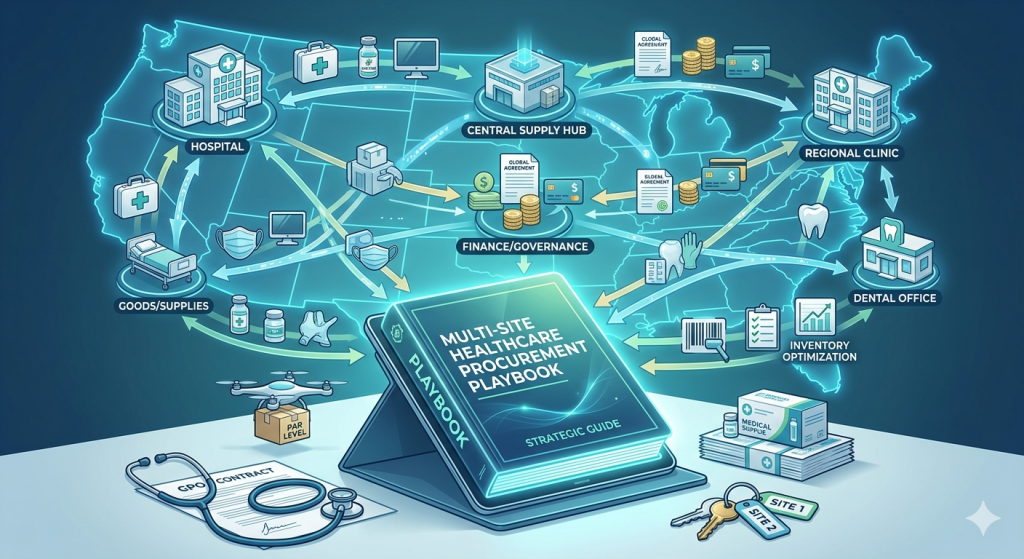
Operator Playbook: Capturing Procurement Value in Multi-Site Healthcare Acquisitions
By Dan Bleicher, Partner, Inside Consulting. Published April 7, 2026.
A practical guide for PE sponsors and C-suite executives at multi-site healthcare platforms.
Executive Summary
Fragmented vendor relationships, opaque spend data, and clinician-driven purchasing leave many PE-backed healthcare platforms carrying a structurally higher cost base than their scale warrants. Procurement is not the most glamorous value-creation lever, but it is among the most reliable: it is directly tied to EBITDA, it is executable early in the hold period, and it builds infrastructure that compounds in value as the platform grows.
This playbook covers the end-to-end mechanics: why fragmentation persists even as platforms scale, how to convert aggregate volume into genuine negotiating leverage, the diagnostic steps required before any vendor conversation, execution mechanics for consolidations and renegotiations, and the governance infrastructure needed to prevent savings from eroding in year two. A dedicated section covers IT spend, which warrants its own treatment given its complexity and strategic importance.
The goal is a repeatable, operator-friendly procurement model that sponsors and management teams can deploy as a standard component of the value-creation plan.
Procurement should be treated as a core operating model pillar, not an administrative afterthought. Platforms that act early and invest in spend visibility are better positioned to capture the compounding advantage of scale.
I. The Problem: Fragmentation by Design
Acquisitions Inherit Fragmented Vendor Relationships
Healthcare platforms typically grow through serial acquisitions of independent practices, centers, or facilities. Each acquired entity arrives with its own incumbent vendors across supplies, services, IT, and revenue cycle, along with site-specific pricing, informal discount arrangements, and long-standing relationships with local sales representatives. This fragmentation is not accidental. It reflects the historical independence of those sites and the operational autonomy routinely granted to local clinical and administrative leaders.
The result is a patchwork of vendor relationships, most of which are undocumented at the platform level and invisible to central finance.
Spend Visibility Is Nonexistent at the Platform Level
In many platforms, the central finance team can see total operating expenses and broad category buckets, but not a detailed, normalized view of spend by category, vendor, and site. Invoices may be coded inconsistently. Contract identifiers and terms may not be captured in any structured way. Without a consolidated view: the platform cannot quantify what it actually spends with each vendor across the enterprise; high-priority categories and vendors are invisible until someone manually assembles the data; and there is no basis for distinguishing clinically sensitive spend from low-risk nonclinical categories where savings are easier to capture.
Scale Accumulates on Paper, Not in Practice
As a platform grows through acquisitions, reported revenue and total spend increase, but the underlying vendor structure often remains as fragmented as it was at half the current size. Instead of buying as one integrated entity, the platform continues to buy as a loose federation of sites. Vendors see a collection of small accounts. The platform’s scale story cannot be monetized in the form of better pricing, terms, or service levels, and synergies promised at close remain unrealized.
II. The Opportunity: Aggregate Volume as a Negotiating Asset
What Consolidated Spend Actually Looks Like
When spend is finally consolidated across sites, operators typically discover that multiple locations are purchasing the same or equivalent items from different vendors at different prices; that small local vendors have become significant enterprise-wide suppliers when their volumes are aggregated; and that a handful of categories account for a disproportionate share of addressable spend and negotiating leverage.
How Volume Leverage Changes Pricing Outcomes
In a fragmented state, each location is a relatively small account. Vendors grant modest discounts based on local competitive dynamics. Once a platform can credibly present its consolidated volume and commit to routing the majority of that volume to a smaller set of preferred vendors, the economics change materially: vendors compete for a larger and more strategic relationship, enterprise pricing replaces site-by-site deals, and nonprice elements, including service levels, training, implementation support, and data-sharing, become negotiable.
Why the Opportunity Is Time-Sensitive
Fragmentation tends to harden over time. The longer a legacy vendor relationship persists, the more embedded it becomes operationally and culturally. Sites sign contract extensions and auto-renewals that reduce flexibility. Clinicians and staff build habits around specific products and systems. Acting early in the hold period allows sponsors and operators to capture low-regret savings in nonclinical and lower-sensitivity categories, establish procurement norms before local patterns are entrenched, and integrate procurement thinking into the integration playbook for future acquisitions.
III. The Diagnostic: Establishing a Spend Baseline
A disciplined procurement program starts with a clear, data-driven answer to a deceptively simple question: where does the money go? This section outlines a pragmatic diagnostic approach for PE-backed platforms.
Building a Consolidated Spend Cube
The core analytic asset is a consolidated spend cube that integrates accounts payable data from all sites into a single, normalized dataset. The key steps are: extract AP data from each entity, including vendor names, invoice dates, amounts, and available category codes; normalize vendor naming so that different instances of the same supplier roll up correctly; and map each line item into a common category structure covering supplies, clinical services, IT, facilities, revenue cycle, and professional services.
The result is a multi-dimensional view of spend by vendor, category and subcategory, site and region, and contract status where known. Even an imperfect first version is far more useful than no baseline at all.
Categorizing Spend and Identifying High-Leverage Opportunities
Once the spend cube is built, categories should be segmented by their potential for value capture across four dimensions: spend magnitude, fragmentation (vendor count and spend distribution), clinical sensitivity, and switching cost. This segmentation drives the sequence of initiatives. The right starting point is high-spend, low-sensitivity categories: areas where consolidation is operationally manageable and clinical resistance is minimal. More complex clinical and IT categories come later, once the organization has early wins and a track record of delivering value rather than disruption.
Benchmarking and Assessing Contract Status
Current pricing should be benchmarked against market rates using third-party data, GPO rate cards, and industry benchmarks wherever available. Even where direct comparisons are difficult, relative analysis across sites for the same product or service can reveal significant pockets of overpayment.
The diagnostic should also overlay contract information: which vendors are covered by formal contracts, what are their terms and expiry dates, and where do informal evergreen arrangements exist? This view reveals where the platform has near-term flexibility and where a staged approach is required.
IV. The Execution: From Visibility to Savings
Prioritizing Categories for Action
A practical prioritization framework considers spend magnitude, switching cost and complexity, contract flexibility, and stakeholder impact in combination. The goal is a staged sequence where early projects require minimal clinician behavior change and deliver visible, quantifiable results. These early wins matter not just financially but as proof points that build organizational confidence in the procurement process.
Vendor Consolidation and Renegotiation Mechanics
For each targeted category, the execution mechanics follow a consistent pattern: identify which vendors can credibly serve the majority of the platform’s volume, run a structured sourcing process (request for proposals, comparative evaluation across price and nonprice factors, enterprise-level negotiation), and rationalize the vendor panel while preserving enough redundancy for operational contingencies.
In clinically sensitive categories, evaluation criteria must go beyond price to include clinical performance, reliability, workflow compatibility, and support services. Platforms that frame vendor changes as value improvements, delivering better outcomes and service at a sustainable cost, are far more likely to earn clinician support than those that lead with cost reduction as the primary rationale.
Addressing Maverick Spend
A significant share of spend in most platforms occurs outside formal contracts or approved vendor lists. This maverick spend typically stems from long-standing relationships with specific sales representatives, site-level habits, and a simple lack of awareness of newly negotiated enterprise agreements. Addressing it requires both process and change management: clear communication of preferred vendors, ordering pathways that make the preferred option the path of least resistance, and monitoring to identify and reduce off-contract purchases.
GPO Enrollment vs. Direct Contracting
Group purchasing organizations are a tool, not a strategy. GPO arrangements can provide an efficient path to competitive pricing, particularly in smaller or lower-priority categories. But platforms should not assume that GPO participation alone delivers optimal outcomes. Where the platform’s scale and strategic importance justify it, direct enterprise agreements with customized terms, performance metrics, and nonprice commitments will typically outperform what is available through a GPO. A blended approach, using GPOs selectively and direct contracting where it creates differentiated value, tends to work best.
V. Building for Scale: Infrastructure That Sustains Savings
One of the most common failure modes in procurement initiatives is capturing one-time savings without building the infrastructure to sustain and compound them. The following elements are essential to a durable procurement model.
Preferred Vendor Lists and Purchasing Policies
Preferred vendor lists by category, with clearly defined conditions for exceptions, are the foundation of ongoing compliance. These should be codified but practical. The goal is to guide purchasing behavior, not to create a bureaucratic structure that drives workarounds.
Contract Lifecycle Management
Platforms should build basic contract management capabilities: central storage and tracking of all contracts, alerts for upcoming expirations and renewals, and visibility into key commercial terms. Without this function, negotiated value leaks through inadvertent auto-renewals, unmanaged price escalators, and missed renegotiation windows. It also supports integration: new acquisitions need a clear, documented path into the platform’s vendor framework.
Governance: Centralized Strategy, Local Input
The most effective governance model combines a centralized vendor strategy and negotiation with structured local input on clinically sensitive categories. Central procurement or operations sets enterprise standards; clinical and site leadership have defined input rights on categories where their expertise and buy-in are critical. This hybrid approach balances standardization with the clinical autonomy that is non-negotiable in healthcare settings.
Integrating Procurement into the M&A Playbook
As the platform continues to acquire, procurement must be part of every integration. This means early capture of AP data from new entities, rapid assessment of overlapping vendors and contracts, and a defined onboarding path to preferred vendors and pricing. Without this, each new acquisition recreates fragmentation and erodes gains made in earlier phases. The platform is perpetually starting over.
VI. The IT Spend Problem: A Category Worth Dedicated Attention
IT spend in healthcare platforms is uniquely fragmented, strategically important, and analytically complex. It warrants its own section in any serious procurement playbook.
Why IT Spend Is Uniquely Fragmented
Acquired sites routinely retain their legacy systems post-close. Local IT vendors and service providers accumulate over time. Shadow IT purchases (software and services procured by departments or individuals outside central oversight) are endemic. A robust IT procurement diagnostic typically reveals overlapping applications serving similar functions across sites, duplicate software licenses purchased independently by different entities, and service contracts with multiple small vendors providing similar infrastructure, security, or support services.
SaaS and Software Rationalization
Beyond core clinical systems, platforms often have dozens of SaaS tools across scheduling, patient engagement, HR, finance, and analytics. A procurement-led review should inventory tools by function, vendor, and actual utilization; identify opportunities to consolidate onto fewer platforms; and align contract renewal dates and pricing models to improve negotiating position. This is an area where procurement and IT must work closely to avoid creating security, interoperability, or compliance issues in the process of achieving savings.
EHR and Practice Management: Consolidation Timing and Economics
Electronic health records and practice management systems are among the most consequential IT categories for healthcare providers. Standardizing on a smaller number of platforms can create long-term benefits in data integrity, workflow consistency, and revenue cycle integration. But consolidation is complex, high-risk, and disruptive. The practical approach is to treat these decisions as part of an overall platform technology strategy rather than as cost-reduction moves, carefully weighing long-term standardization benefits against near-term migration costs and operational risk.
When to Consolidate Aggressively vs. Standardize and Wait
A useful rule of thumb: consolidate aggressively where there is clear redundancy, low operational risk, and high maintainable savings. In areas where immediate consolidation is impractical, including complex clinical systems, regulatory-linked applications, and categories mid-transition, standardize terms and renewal cycles now so that future consolidation is easier and better-leveraged.
VII. Category-Specific Considerations
Clinical Preference Items
Clinician and physician preference plays a central role in many supply and equipment categories. Attempts to change vendors without clinician engagement almost always face resistance and frequently fail. The more effective approach involves co-designing procurement criteria with clinical leaders, evaluating options on outcomes, patient experience, and workflow impact alongside cost, and using pilot programs and data-sharing to demonstrate that alternatives can deliver comparable or better results. Clinician alignment is not a soft issue. It is a critical success factor in any clinically sensitive category.
Facilities, Utilities, and Waste Management
By contrast, facilities-related categories are typically material in spend, operationally important but not clinically sensitive, and amenable to standardized contracts and competitive sourcing. These categories are natural candidates for early-stage consolidation initiatives, where the platform can build momentum and demonstrate the value of a structured procurement approach without the complications of clinical change management.
Revenue Cycle and Billing Vendors
Revenue cycle and billing services are often outsourced across platforms, with multiple vendors operating under different fee structures and delivering inconsistent performance levels. Standardizing or consolidating in this area requires careful analysis of both cost and performance outcomes. It also intersects with broader revenue cycle improvement initiatives, which are among the highest-priority operational levers for most healthcare platforms.
VIII. Common Pitfalls
The most common failure mode is not a bad strategy. It is weak execution and governance.
Starting Negotiations Before Completing the Diagnostic
Entering vendor negotiations without a consolidated view of spend, contracts, and stakeholder needs leads to underpowered conversations. The platform cannot credibly represent its full volume, and without that credibility, vendors have little reason to offer enterprise pricing. The diagnostic is not an optional preparation. It is the source of negotiating power.
Underestimating Clinical Resistance
Statements like “we have a relationship with that rep” or “we’ve always used this vendor” typically signal deeper concerns about product quality, service responsiveness, or fear of workflow disruption. Treating these as soft obstacles to be managed around rather than real concerns to be addressed is a reliable way to stall a procurement initiative. The answer is clinical engagement, clear data, and a credible value case. Organizational pressure alone will not get you there.
Underestimating Contract Transition Timelines
Categories tied to regulatory requirements, accreditation, or credentialing often have complex onboarding and offboarding processes, mandatory notice periods, and dependencies on licensing. Failing to plan for these realities creates operational risk and erodes management credibility on future initiatives.
Treating GPO Enrollment as a Strategy
GPO participation can be a valuable tool but is not a substitute for a procurement strategy. Assuming that joining a GPO guarantees competitive pricing, or that GPO categories are automatically aligned with the platform’s clinical and operational needs, leads to complacency rather than optimized outcomes.
Winning a Price Without Governing Compliance
Negotiating a better price on paper is only the beginning. Without governance infrastructure, sites continue buying from legacy vendors, off-contract purchases erode negotiated discounts, and new acquisitions are never integrated into preferred vendor frameworks. The savings exist in a contract document but not in the financial statements.
Lack of Clear Ownership
Procurement initiatives frequently fall into the gap between finance, operations, and clinical leadership. Without an explicitly named owner with C-suite and sponsor-level sponsorship, decisions get deferred, accountability diffuses, and momentum stalls. Assigning clear ownership is not a soft organizational consideration. It is a prerequisite for execution.
Initiative Fatigue
Healthcare platforms manage simultaneous priorities across clinical quality, compliance, integration, and growth. Procurement can be deprioritized when urgent operational issues arise. The mitigation is sequencing initiatives to deliver early, visible wins; integrating procurement into existing governance forums rather than running it as a standalone project; and making explicit how procurement supports rather than competes with clinical and strategic goals.
Conclusion
Procurement in healthcare platforms is often treated as a back-office function. In practice, it is a powerful and underutilized value-creation lever. When approached systematically, it reduces structural costs without compromising clinical quality, improves consistency and scalability across sites, and builds the data infrastructure and vendor relationships that make a platform more attractive at exit.
For PE sponsors and C-suite executives, the implication is clear: procurement should be embedded in the platform playbook from the earliest stages of the hold period, not added as a cleanup project in year three. Platforms that act early, investing in spend visibility, executing disciplined category strategies, and building governance that sustains gains through ongoing M&A, capture a compounding advantage that their less organized competitors simply cannot replicate.
IX. Procurement Readiness Scorecard
Use this scorecard to assess your platform’s procurement capabilities across five domains. For each question, assign a score of 1 (None / Ad Hoc), 2 (Partial), 3 (Defined), or 4 (Optimized). Sum your column totals to arrive at a composite score out of 80.
Domain A: Spend Visibility
AP data from all sites has been extracted and loaded into a single, normalized spend dataset. Vendor naming is standardized so that different instances of the same supplier roll up to one record. Spend is mapped to a common category structure (supplies, clinical services, IT, facilities, RCM, professional services). Contract status is tracked for major vendors: formal contract vs. evergreen/informal, expiry dates, and key terms. Current pricing has been benchmarked against market rates or compared across sites for the same product or service.
Domain B: Sourcing Execution
High-leverage categories have been identified and sequenced by spend magnitude, switching cost, and clinical sensitivity. At least one category has been through a structured sourcing process with competitive evaluation and enterprise-level negotiation. Vendor consolidation has been completed or is underway in one or more nonclinical categories. Off-contract (maverick) spend is measured and a process exists to route purchasing to preferred vendors. Clinically sensitive categories have a defined engagement process that includes clinical leadership in evaluation and decision-making.
Domain C: Governance and Compliance
Preferred vendor lists exist by category, with defined conditions for exceptions. A contract lifecycle management process is in place: central storage, expiry alerts, and visibility into key commercial terms. Procurement has a clearly named owner with defined accountability and C-suite or sponsor-level sponsorship. Off-contract purchasing is monitored and reported on a regular basis. Governance combines centralized vendor strategy with structured local input for clinically sensitive categories.
Domain D: IT Spend Management
SaaS and software tools have been inventoried by function, vendor, site, and actual utilization. Duplicate or overlapping applications and licenses have been identified across sites. IT vendor contracts are centrally stored and renewal dates are tracked. A SaaS rationalization review has been completed or is in progress in collaboration with IT. EHR and practice management system consolidation has been evaluated with a clear decision on timing and approach.
Domain E: M&A Integration
AP data from new acquisitions is captured and normalized within a defined period post-close. A defined onboarding path exists to bring new sites onto the platform’s preferred vendor framework. Procurement is included as a standing workstream in the integration playbook for every acquisition. Overlapping vendors and contracts from new acquisitions are assessed within 90 days of close.
Score interpretation: 68-80: Tier 1 (Procurement-Ready Platform). 45-67: Tier 2 (Developing Infrastructure). 20-44: Tier 3 (Fragmented / High Risk). For platforms in Tier 2 or Tier 3, the domain with the lowest subtotal is the right starting point. Building spend visibility (Domain A) is the prerequisite for everything that follows.
About Inside Consulting
Inside Consulting works with PE sponsors and C-suite leaders to build spend visibility, execute vendor consolidations, and design healthcare procurement transformation infrastructure that scales. Contact: [email protected]. Website: insideconsulting.net.
About the Author
Dan Bleicher is a Partner at Inside Consulting with more than 11 years of management consulting experience, including McKinsey and Company. He specializes in procurement transformation, supply chain optimization, and operational value creation across healthcare, pharmaceuticals, and advanced industries. Dan graduated from the United States Naval Academy and earned an MBA from Dartmouth’s Tuck School of Business.
Inside Consulting | Healthcare

Dan Bleicher, Partner, Inside Consulting
Published April 7, 2026
Operator Playbook
A practical guide for PE sponsors and C-suite executives at multi-site healthcare platforms.
Executive Summary
Fragmented vendor relationships, opaque spend data, and clinician-driven purchasing leave many PE-backed healthcare platforms carrying a structurally higher cost base than their scale warrants. Procurement is not the most glamorous value-creation lever, but it is among the most reliable: it is directly tied to EBITDA, it is executable early in the hold period, and it builds infrastructure that compounds in value as the platform grows.
This playbook covers the end-to-end mechanics: why fragmentation persists even as platforms scale, how to convert aggregate volume into genuine negotiating leverage, the diagnostic steps required before any vendor conversation, execution mechanics for consolidations and renegotiations, and the governance infrastructure needed to prevent savings from eroding in year two. A dedicated section covers IT spend, which warrants its own treatment given its complexity and strategic importance.
The goal is a repeatable, operator-friendly procurement model that sponsors and management teams can deploy as a standard component of the value-creation plan.
Procurement should be treated as a core operating model pillar, not an administrative afterthought. Platforms that act early and invest in spend visibility are better positioned to capture the compounding advantage of scale.
I. The Problem: Fragmentation by Design
Acquisitions Inherit Fragmented Vendor Relationships
Healthcare platforms typically grow through serial acquisitions of independent practices, centers, or facilities. Each acquired entity arrives with its own incumbent vendors across supplies, services, IT, and revenue cycle, along with site-specific pricing, informal discount arrangements, and long-standing relationships with local sales representatives. This fragmentation is not accidental. It reflects the historical independence of those sites and the operational autonomy routinely granted to local clinical and administrative leaders.
The result is a patchwork of vendor relationships, most of which are undocumented at the platform level and invisible to central finance.
Spend Visibility Is Nonexistent at the Platform Level
In many platforms, the central finance team can see total operating expenses and broad category buckets, but not a detailed, normalized view of spend by category, vendor, and site. Invoices may be coded inconsistently. Contract identifiers and terms may not be captured in any structured way. Without a consolidated view:
- The platform cannot quantify what it actually spends with each vendor across the enterprise.
- High-priority categories and vendors are invisible until someone manually assembles the data.
- There is no basis for distinguishing clinically sensitive spend from low-risk nonclinical categories where savings are easier to capture.
Scale Accumulates on Paper, Not in Practice
As a platform grows through acquisitions, reported revenue and total spend increase, but the underlying vendor structure often remains as fragmented as it was at half the current size. Instead of buying as one integrated entity, the platform continues to buy as a loose federation of sites. Vendors see a collection of small accounts. The platform’s scale story cannot be monetized in the form of better pricing, terms, or service levels, and synergies promised at close remain unrealized.
II. The Opportunity: Aggregate Volume as a Negotiating Asset
What Consolidated Spend Actually Looks Like
When spend is finally consolidated across sites, operators typically discover that multiple locations are purchasing the same or equivalent items from different vendors at different prices; that small local vendors have become significant enterprise-wide suppliers when their volumes are aggregated; and that a handful of categories account for a disproportionate share of addressable spend and negotiating leverage.
How Volume Leverage Changes Pricing Outcomes
In a fragmented state, each location is a relatively small account. Vendors grant modest discounts based on local competitive dynamics. Once a platform can credibly present its consolidated volume and commit to routing the majority of that volume to a smaller set of preferred vendors, the economics change materially: vendors compete for a larger and more strategic relationship, enterprise pricing replaces site-by-site deals, and nonprice elements, including service levels, training, implementation support, and data-sharing, become negotiable.
Why the Opportunity Is Time-Sensitive
Fragmentation tends to harden over time. The longer a legacy vendor relationship persists, the more embedded it becomes operationally and culturally. Sites sign contract extensions and auto-renewals that reduce flexibility. Clinicians and staff build habits around specific products and systems. Acting early in the hold period allows sponsors and operators to capture low-regret savings in nonclinical and lower-sensitivity categories, establish procurement norms before local patterns are entrenched, and integrate procurement thinking into the integration playbook for future acquisitions.
III. The Diagnostic: Establishing a Spend Baseline
A disciplined procurement program starts with a clear, data-driven answer to a deceptively simple question: where does the money go? This section outlines a pragmatic diagnostic approach for PE-backed platforms.
Building a Consolidated Spend Cube
The core analytic asset is a consolidated spend cube that integrates accounts payable data from all sites into a single, normalized dataset. The key steps are straightforward in concept and often laborious in practice:
- Extract AP data from each entity, including vendor names, invoice dates, amounts, and available category codes.
- Normalize vendor naming so that different instances of the same supplier roll up correctly.
- Map each line item into a common category structure covering supplies, clinical services, IT, facilities, revenue cycle, and professional services.
The result is a multi-dimensional view of spend by vendor, category and subcategory, site and region, and contract status where known. Even an imperfect first version is far more useful than no baseline at all.
Categorizing Spend and Identifying High-Leverage Opportunities
Once the spend cube is built, categories should be segmented by their potential for value capture across four dimensions: spend magnitude, fragmentation (vendor count and spend distribution), clinical sensitivity, and switching cost. This segmentation drives the sequence of initiatives. The right starting point is high-spend, low-sensitivity categories: areas where consolidation is operationally manageable and clinical resistance is minimal. More complex clinical and IT categories come later, once the organization has early wins and a track record of delivering value rather than disruption.
Benchmarking and Assessing Contract Status
Current pricing should be benchmarked against market rates using third-party data, GPO rate cards, and industry benchmarks wherever available. Even where direct comparisons are difficult, relative analysis across sites for the same product or service can reveal significant pockets of overpayment.
The diagnostic should also overlay contract information: which vendors are covered by formal contracts, what are their terms and expiry dates, and where do informal evergreen arrangements exist? This view reveals where the platform has near-term flexibility and where a staged approach is required.
IV. The Execution: From Visibility to Savings
Prioritizing Categories for Action
A practical prioritization framework considers spend magnitude, switching cost and complexity, contract flexibility, and stakeholder impact in combination. The goal is a staged sequence where early projects require minimal clinician behavior change and deliver visible, quantifiable results. These early wins matter not just financially but as proof points that build organizational confidence in the procurement process.
Vendor Consolidation and Renegotiation Mechanics
For each targeted category, the execution mechanics follow a consistent pattern: identify which vendors can credibly serve the majority of the platform’s volume, run a structured sourcing process (request for proposals, comparative evaluation across price and nonprice factors, enterprise-level negotiation), and rationalize the vendor panel while preserving enough redundancy for operational contingencies.
In clinically sensitive categories, evaluation criteria must go beyond price to include clinical performance, reliability, workflow compatibility, and support services. Platforms that frame vendor changes as value improvements, delivering better outcomes and service at a sustainable cost, are far more likely to earn clinician support than those that lead with cost reduction as the primary rationale.
Addressing Maverick Spend
A significant share of spend in most platforms occurs outside formal contracts or approved vendor lists. This maverick spend typically stems from long-standing relationships with specific sales representatives, site-level habits, and a simple lack of awareness of newly negotiated enterprise agreements. Addressing it requires both process and change management: clear communication of preferred vendors, ordering pathways that make the preferred option the path of least resistance, and monitoring to identify and reduce off-contract purchases.
GPO Enrollment vs. Direct Contracting
Group purchasing organizations are a tool, not a strategy. GPO arrangements can provide an efficient path to competitive pricing, particularly in smaller or lower-priority categories. But platforms should not assume that GPO participation alone delivers optimal outcomes. Where the platform’s scale and strategic importance justify it, direct enterprise agreements with customized terms, performance metrics, and nonprice commitments will typically outperform what is available through a GPO. A blended approach, using GPOs selectively and direct contracting where it creates differentiated value, tends to work best.
V. Building for Scale: Infrastructure That Sustains Savings
One of the most common failure modes in procurement initiatives is capturing one-time savings without building the infrastructure to sustain and compound them. The following elements are essential to a durable procurement model.
Preferred Vendor Lists and Purchasing Policies
Preferred vendor lists by category, with clearly defined conditions for exceptions, are the foundation of ongoing compliance. These should be codified but practical. The goal is to guide purchasing behavior, not to create a bureaucratic structure that drives workarounds.
Contract Lifecycle Management
Platforms should build basic contract management capabilities: central storage and tracking of all contracts, alerts for upcoming expirations and renewals, and visibility into key commercial terms. Without this function, negotiated value leaks through inadvertent auto-renewals, unmanaged price escalators, and missed renegotiation windows. It also supports integration: new acquisitions need a clear, documented path into the platform’s vendor framework.
Governance: Centralized Strategy, Local Input
The most effective governance model combines a centralized vendor strategy and negotiation with structured local input on clinically sensitive categories. Central procurement or operations sets enterprise standards; clinical and site leadership have defined input rights on categories where their expertise and buy-in are critical. This hybrid approach balances standardization with the clinical autonomy that is non-negotiable in healthcare settings.
Integrating Procurement into the M&A Playbook
As the platform continues to acquire, procurement must be part of every integration. This means early capture of AP data from new entities, rapid assessment of overlapping vendors and contracts, and a defined onboarding path to preferred vendors and pricing. Without this, each new acquisition recreates fragmentation and erodes gains made in earlier phases. The platform is perpetually starting over.
VI. The IT Spend Problem: A Category Worth Dedicated Attention
IT spend in healthcare platforms is uniquely fragmented, strategically important, and analytically complex. It warrants its own section in any serious procurement playbook.
Why IT Spend Is Uniquely Fragmented
Acquired sites routinely retain their legacy systems post-close. Local IT vendors and service providers accumulate over time. Shadow IT purchases (software and services procured by departments or individuals outside central oversight) are endemic. A robust IT procurement diagnostic typically reveals overlapping applications serving similar functions across sites, duplicate software licenses purchased independently by different entities, and service contracts with multiple small vendors providing similar infrastructure, security, or support services.
SaaS and Software Rationalization
Beyond core clinical systems, platforms often have dozens of SaaS tools across scheduling, patient engagement, HR, finance, and analytics. A procurement-led review should inventory tools by function, vendor, and actual utilization; identify opportunities to consolidate onto fewer platforms; and align contract renewal dates and pricing models to improve negotiating position. This is an area where procurement and IT must work closely to avoid creating security, interoperability, or compliance issues in the process of achieving savings.
EHR and Practice Management: Consolidation Timing and Economics
Electronic health records and practice management systems are among the most consequential IT categories for healthcare providers. Standardizing on a smaller number of platforms can create long-term benefits in data integrity, workflow consistency, and revenue cycle integration. But consolidation is complex, high-risk, and disruptive. The practical approach is to treat these decisions as part of an overall platform technology strategy rather than as cost-reduction moves, carefully weighing long-term standardization benefits against near-term migration costs and operational risk.
When to Consolidate Aggressively vs. Standardize and Wait
A useful rule of thumb: consolidate aggressively where there is clear redundancy, low operational risk, and high maintainable savings. In areas where immediate consolidation is impractical, including complex clinical systems, regulatory-linked applications, and categories mid-transition, standardize terms and renewal cycles now so that future consolidation is easier and better-leveraged.
VII. Category-Specific Considerations
Clinical Preference Items
Clinician and physician preference plays a central role in many supply and equipment categories. Attempts to change vendors without clinician engagement almost always face resistance and frequently fail. The more effective approach involves co-designing procurement criteria with clinical leaders, evaluating options on outcomes, patient experience, and workflow impact alongside cost, and using pilot programs and data-sharing to demonstrate that alternatives can deliver comparable or better results. Clinician alignment is not a soft issue. It is a critical success factor in any clinically sensitive category.
Facilities, Utilities, and Waste Management
By contrast, facilities-related categories are typically material in spend, operationally important but not clinically sensitive, and amenable to standardized contracts and competitive sourcing. These categories are natural candidates for early-stage consolidation initiatives, where the platform can build momentum and demonstrate the value of a structured procurement approach without the complications of clinical change management.
Revenue Cycle and Billing Vendors
Revenue cycle and billing services are often outsourced across platforms, with multiple vendors operating under different fee structures and delivering inconsistent performance levels. Standardizing or consolidating in this area requires careful analysis of both cost and performance outcomes. It also intersects with broader revenue cycle improvement initiatives, which are among the highest-priority operational levers for most healthcare platforms.
VIII. Common Pitfalls
The most common failure mode is not a bad strategy. It is weak execution and governance.
Starting Negotiations Before Completing the Diagnostic
Entering vendor negotiations without a consolidated view of spend, contracts, and stakeholder needs leads to underpowered conversations. The platform cannot credibly represent its full volume, and without that credibility, vendors have little reason to offer enterprise pricing. The diagnostic is not an optional preparation. It is the source of negotiating power.
Underestimating Clinical Resistance
Statements like “we have a relationship with that rep” or “we’ve always used this vendor” typically signal deeper concerns about product quality, service responsiveness, or fear of workflow disruption. Treating these as soft obstacles to be managed around rather than real concerns to be addressed is a reliable way to stall a procurement initiative. The answer is clinical engagement, clear data, and a credible value case. Organizational pressure alone will not get you there.
Underestimating Contract Transition Timelines
Categories tied to regulatory requirements, accreditation, or credentialing often have complex onboarding and offboarding processes, mandatory notice periods, and dependencies on licensing. Failing to plan for these realities creates operational risk and erodes management credibility on future initiatives.
Treating GPO Enrollment as a Strategy
GPO participation can be a valuable tool but is not a substitute for a procurement strategy. Assuming that joining a GPO guarantees competitive pricing, or that GPO categories are automatically aligned with the platform’s clinical and operational needs, leads to complacency rather than optimized outcomes.
Winning a Price Without Governing Compliance
Negotiating a better price on paper is only the beginning. Without governance infrastructure, sites continue buying from legacy vendors, off-contract purchases erode negotiated discounts, and new acquisitions are never integrated into preferred vendor frameworks. The savings exist in a contract document but not in the financial statements.
Lack of Clear Ownership
Procurement initiatives frequently fall into the gap between finance, operations, and clinical leadership. Without an explicitly named owner with C-suite and sponsor-level sponsorship, decisions get deferred, accountability diffuses, and momentum stalls. Assigning clear ownership is not a soft organizational consideration. It is a prerequisite for execution.
Initiative Fatigue
Healthcare platforms manage simultaneous priorities across clinical quality, compliance, integration, and growth. Procurement can be deprioritized when urgent operational issues arise. The mitigation is sequencing initiatives to deliver early, visible wins; integrating procurement into existing governance forums rather than running it as a standalone project; and making explicit how procurement supports rather than competes with clinical and strategic goals.
Conclusion
Procurement in healthcare platforms is often treated as a back-office function. In practice, it is a powerful and underutilized value-creation lever. When approached systematically, it reduces structural costs without compromising clinical quality, improves consistency and scalability across sites, and builds the data infrastructure and vendor relationships that make a platform more attractive at exit.
For PE sponsors and C-suite executives, the implication is clear: procurement should be embedded in the platform playbook from the earliest stages of the hold period, not added as a cleanup project in year three. Platforms that act early, investing in spend visibility, executing disciplined category strategies, and building governance that sustains gains through ongoing M&A, capture a compounding advantage that their less organized competitors simply cannot replicate. If your platform is ready to move from diagnosis to execution, our healthcare procurement transformation practice covers the full engagement model, category coverage, and client results.
IX. Procurement Readiness Scorecard
Use this scorecard to assess your platform’s procurement capabilities across five domains. For each question, assign a score of 1 (None / Ad Hoc), 2 (Partial), 3 (Defined), or 4 (Optimized). Check the box in the column that best reflects current practice. Sum your column totals, then multiply: (1×n₁) + (2×n₂) + (3×n₃) + (4×n₄) to arrive at a composite score out of 80.
A score reflects the state of the infrastructure, not the ambition. The gap between where you are and where the opportunity sits is the value-creation case.
| Domain |
Assessment Question |
1 |
2 |
3 |
4 |
|
None /
Ad Hoc |
Partial |
Defined |
Optimized |
| A. Spend Visibility |
|
AP data from all sites has been extracted and loaded into a single, normalized spend dataset. |
|
|
|
|
|
Vendor naming is standardized so that different instances of the same supplier roll up to one record. |
|
|
|
|
|
Spend is mapped to a common category structure (supplies, clinical services, IT, facilities, RCM, professional services). |
|
|
|
|
|
Contract status is tracked for major vendors: formal contract vs. evergreen/informal, expiry dates, and key terms. |
|
|
|
|
|
Current pricing has been benchmarked against market rates or compared across sites for the same product or service. |
|
|
|
|
| A Subtotal |
___ |
___ |
___ |
___ |
| B. Sourcing Execution |
|
High-leverage categories have been identified and sequenced by spend magnitude, switching cost, and clinical sensitivity. |
|
|
|
|
|
At least one category has been through a structured sourcing process with competitive evaluation and enterprise-level negotiation. |
|
|
|
|
|
Vendor consolidation has been completed or is underway in one or more nonclinical categories. |
|
|
|
|
|
Off-contract (maverick) spend is measured and a process exists to route purchasing to preferred vendors. |
|
|
|
|
|
Clinically sensitive categories have a defined engagement process that includes clinical leadership in evaluation and decision-making. |
|
|
|
|
| B Subtotal |
___ |
___ |
___ |
___ |
| C. Governance & Compliance |
|
Preferred vendor lists exist by category, with defined conditions for exceptions. |
|
|
|
|
|
A contract lifecycle management process is in place: central storage, expiry alerts, and visibility into key commercial terms. |
|
|
|
|
|
Procurement has a clearly named owner with defined accountability and C-suite or sponsor-level sponsorship. |
|
|
|
|
|
Off-contract purchasing is monitored and reported on a regular basis. |
|
|
|
|
|
Governance combines centralized vendor strategy with structured local input for clinically sensitive categories. |
|
|
|
|
| C Subtotal |
___ |
___ |
___ |
___ |
| D. IT Spend Management |
|
SaaS and software tools have been inventoried by function, vendor, site, and actual utilization. |
|
|
|
|
|
Duplicate or overlapping applications and licenses have been identified across sites. |
|
|
|
|
|
IT vendor contracts are centrally stored and renewal dates are tracked. |
|
|
|
|
|
A SaaS rationalization review has been completed or is in progress in collaboration with IT. |
|
|
|
|
|
EHR and practice management system consolidation has been evaluated with a clear decision on timing and approach. |
|
|
|
|
| D Subtotal |
___ |
___ |
___ |
___ |
| E. M&A Integration |
|
AP data from new acquisitions is captured and normalized within a defined period post-close. |
|
|
|
|
|
A defined onboarding path exists to bring new sites onto the platform’s preferred vendor framework. |
|
|
|
|
|
Procurement is included as a standing workstream in the integration playbook for every acquisition. |
|
|
|
|
|
Overlapping vendors and contracts from new acquisitions are assessed within 90 days of close. |
|
|
|
|
| Column Subtotals |
___ |
___ |
___ |
___ |
Composite Score = (1×n₁) + (2×n₂) + (3×n₃) + (4×n₄)
Maximum: 80
| Score |
Readiness Tier |
What It Means |
| 68–80 |
Tier 1: Procurement-Ready Platform |
The platform has built the foundational infrastructure for sustainable procurement value. Focus shifts to ongoing optimization, category expansion, and compounding savings through M&A integration. |
| 45–67 |
Tier 2: Developing Infrastructure |
Meaningful progress has been made, but gaps in visibility, governance, or integration are limiting the platform’s ability to capture and sustain savings. Prioritize the lowest-scoring domain as the next workstream. |
| 20–44 |
Tier 3: Fragmented / High Risk |
The platform is carrying structural cost above what its scale warrants. Spend is fragmented, leverage is unrealized, and savings negotiated in one period are unlikely to hold without foundational fixes in data, ownership, and governance. |
For platforms in Tier 2 or Tier 3, the domain with the lowest subtotal is the right starting point. Building spend visibility (Domain A) is the prerequisite for everything that follows.
Ready to quantify the opportunity at your platform?
Inside Consulting works with PE sponsors and C-suite leaders to build spend visibility, execute vendor consolidations, and design healthcare procurement transformation infrastructure that scales.
[email protected] | insideconsulting.net
References
The following sources are cited in this paper. Authors should verify that the specific claims attributed to each source are confirmed in the original text before final distribution.
- Porter, M.E. and Lee, T.H. “The Strategy That Will Fix Health Care.” Harvard Business Review, October 2013. hbr.org
- Blumenthal, D. and Jena, A.B. “Hospital Value-Based Purchasing.” JAMA Internal Medicine, 2013. jamanetwork.com
- BCG. “How Procurement Unlocks Value-Based Health Care.” Boston Consulting Group, 2020. bcg.com
- McKinsey & Company. “Private Equity Opportunities in Healthcare Tech.” mckinsey.com
- McKinsey & Company. “US Healthcare Companies Continue to Create Value Through Diversification.” mckinsey.com
- Harvard T.H. Chan School of Public Health. Working paper on procurement and supply-chain cost interventions in health systems. dash.harvard.edu
(Read the Text Only Version Here)
About the Author
Dan Bleicher Partner, Inside Consulting
Dan is a Partner at Inside Consulting with more than 11 years of management consulting experience, including McKinsey & Company. He specializes in procurement transformation, supply chain optimization, and operational value creation across healthcare, pharmaceuticals, and advanced industries. Dan graduated from the United States Naval Academy and earned an MBA from Dartmouth’s Tuck School of Business.
Connect on LinkedIn →